Oil on canvas · Exhibited 1806 · Tate
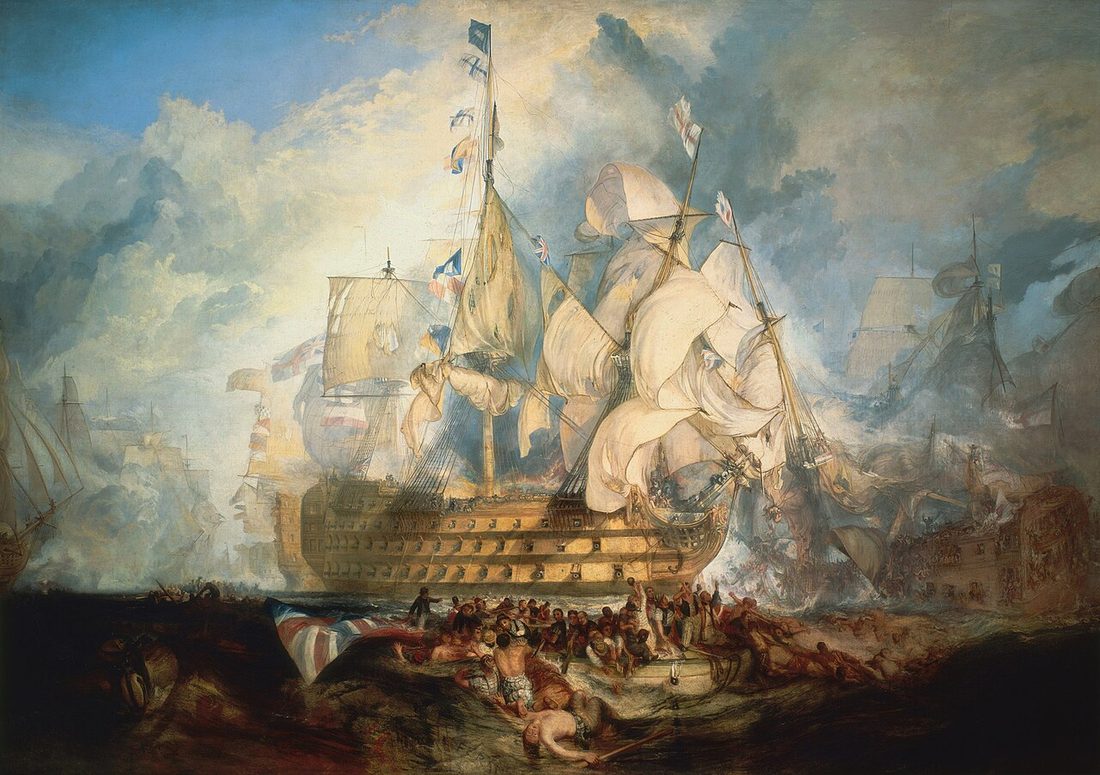
The Battle of Trafalgar, as Seen from the Mizen Shrouds of the Victory
Turner boarded the Victory when she came home and drew her. Then he painted Trafalgar from a viewpoint inside the rigging, which nobody had done.
.jpg)
The viewpoint
Turner's exhibition title specifies where the viewer is standing: in the mizen starboard shrouds of the Victory, part way up the rigging near the stern. That places us aboard the flagship in the middle of the action rather than at the safe middle distance a naval picture would conventionally choose.
| Artist | Joseph Mallord William Turner (1775–1851) |
|---|---|
| Date | 1806 |
| Exhibited | Royal Academy, 1806 |
| Medium | Oil paint on canvas |
| Dimensions | support: 1708 x 2388 mm frame: 2181 x 2860 x 190 mm |
| Collection | Tate, London |
| Accession number | N00480 |
| Credit line | Accepted by the nation as part of the Turner Bequest 1856 |
The consequence is disorder. Masts and rigging cut across the canvas, the ships are partly obscured by each other and by smoke, and no single vessel is presented whole. A viewer looking for the clear tactical arrangement of a battle piece does not get one, which was the main complaint at the time.
He went aboard the ship
The Victory returned to the Medway in December 1805, carrying Nelson's body home, and Turner went down to see her. Sketchbook pages survive recording her hull, her damaged rigging and details of her stern, and he also took down accounts from crew members while the ship was still in that condition.
That research underpins everything that is unusual about the finished picture. The confusion in the composition is not vagueness at all but a reconstruction of what the battle would have looked like from one specific position, built up from drawings of the actual ship rather than from a printed plan of the engagement.
The 1806 reception
Critics were unhappy, and the objections were about legibility instead of handling. Reviewers wanted to be able to read the battle, identify the ships and locate Nelson, and Turner had deliberately made all three difficult. Several notices treated the picture as a failure of the basic duty of a naval painting.
He was also caught rather awkwardly between two conventions here. A national victory with a dead national hero invited a commemorative treatment, and what he produced instead was something much closer to an eyewitness account of chaos, which satisfied neither the patriotic expectation nor the contemporary taste for orderly marine painting.
The later Trafalgar
Turner returned to the subject in a much larger canvas commissioned for St James's Palace in the 1820s, now held at the National Maritime Museum. That version is far more conventional in its arrangement and was altered at the request of naval officers who objected to inaccuracies, which he resented.
What the title does
Specifying the mizen starboard shrouds in an exhibition title is an unusual move, and it functions as a defence written in advance. A viewer told exactly where they are standing has been given the reason the picture is hard to read, before they have had the chance to complain about it.
Where to see it
This canvas is at Tate in London as part of the Turner Bequest. The later royal commission is at Greenwich, so the two Trafalgars can be compared directly, and the comparison is instructive: the earlier, unsold picture is the more original, and the later, paid one is the more obliging.
Questions
Is there a second Turner painting of Trafalgar?
Yes, a much larger canvas commissioned for St James's Palace in the 1820s and now held at the National Maritime Museum in Greenwich. That version is far more conventionally arranged, and it was altered at the request of naval officers who objected to inaccuracies, which Turner is recorded as having resented.
Did Turner see the Battle of Trafalgar?
No. He saw the Victory when she returned to the Medway in December 1805 carrying Nelson's body, and sketchbook pages survive recording her hull, her damaged rigging and details of her stern. He also took down accounts from crew members, so the picture is reconstruction from direct research and not eyewitness.
Why did critics dislike it?
Because they could not read it. Reviewers wanted to identify the ships, follow the tactical arrangement and locate Nelson, and Turner's viewpoint inside the Victory's rigging made all three difficult. Several notices treated that as a failure of the basic duty of a naval painting rather than as a deliberate choice.